
Why This Artist Paints Emotion as Strength, Not Weakness
Interview: Artist Ross Collado
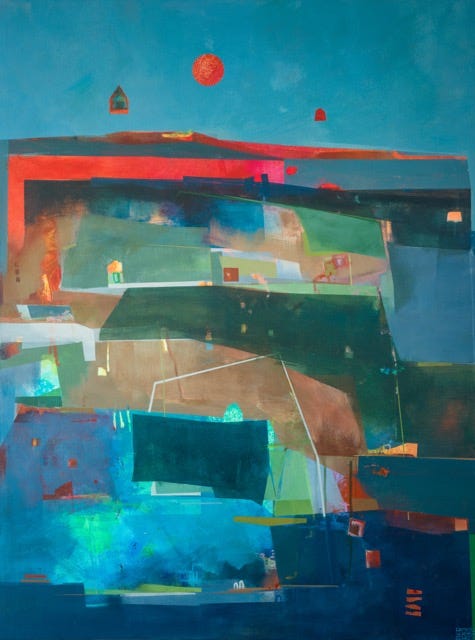
Last month walking through the Other Art Fair in LA, there were a handful of artists who caught my eye. One of those was Ross Collado, a Filipino American abstract artist whose work feels urgent and calming at the same time. This is purposeful, of course, Collado is inspired by nature and all of its complexity - from the calm serenity to the unexpected turbulence.
Collado’s art asks you to move - first, close enough to notice the quiet notations and small shifts of color and then to step back and let the edges and figures (buildings, cars, trees?) settle into place.
Collado, a self-taught painter, lets vulnerability bleed onto the surface—edges that dissolve, horizons that hint, blues that feel like distance and time. In this interview, we talk about memory, material, and the studio rhythms that let a painting speak for itself.
You’ve said that where you grew up, showing emotion was seen as a weakness. How does your work reframe that?
Growing up [in the Philippines], showing emotion—especially as a man—was seen as a kind of weakness. You were supposed to stay composed, not let people see what was going on inside.
My work pushes against that. When I paint, I let those emotions out—vulnerability, tenderness, confusion, love. It’s my way of saying that feeling deeply isn’t something to hide; it’s powerful. I want my work to make people feel it’s okay to be open—that emotion is strength, not weakness.
“I want my work to make people feel it’s okay to be open—that emotion is strength, not weakness.”
Which memories from the Philippines keep resurfacing in your paintings?
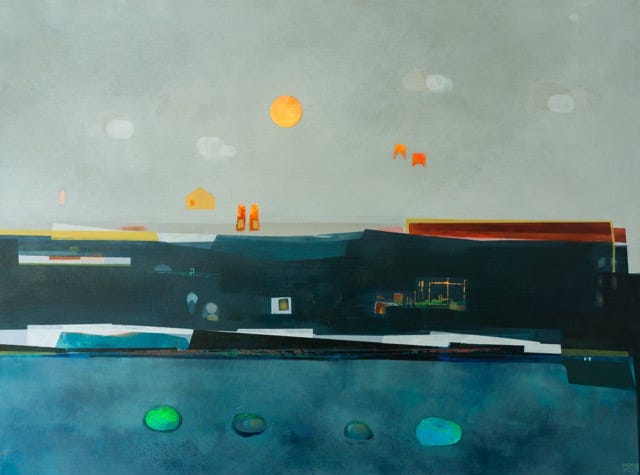
A lot of memories from the Philippines come through—mostly feelings rather than specific scenes: heat, light, the colors of the sky at dusk, the sound of rain on tin roofs.
I think about childhood moments too—quiet afternoons, family gatherings, that mix of joy and longing that stays with you. Those memories aren’t literal in my paintings, but they show up in the atmosphere, textures, and moods. It’s like I’m always painting pieces of where I came from, even when I don’t mean to.
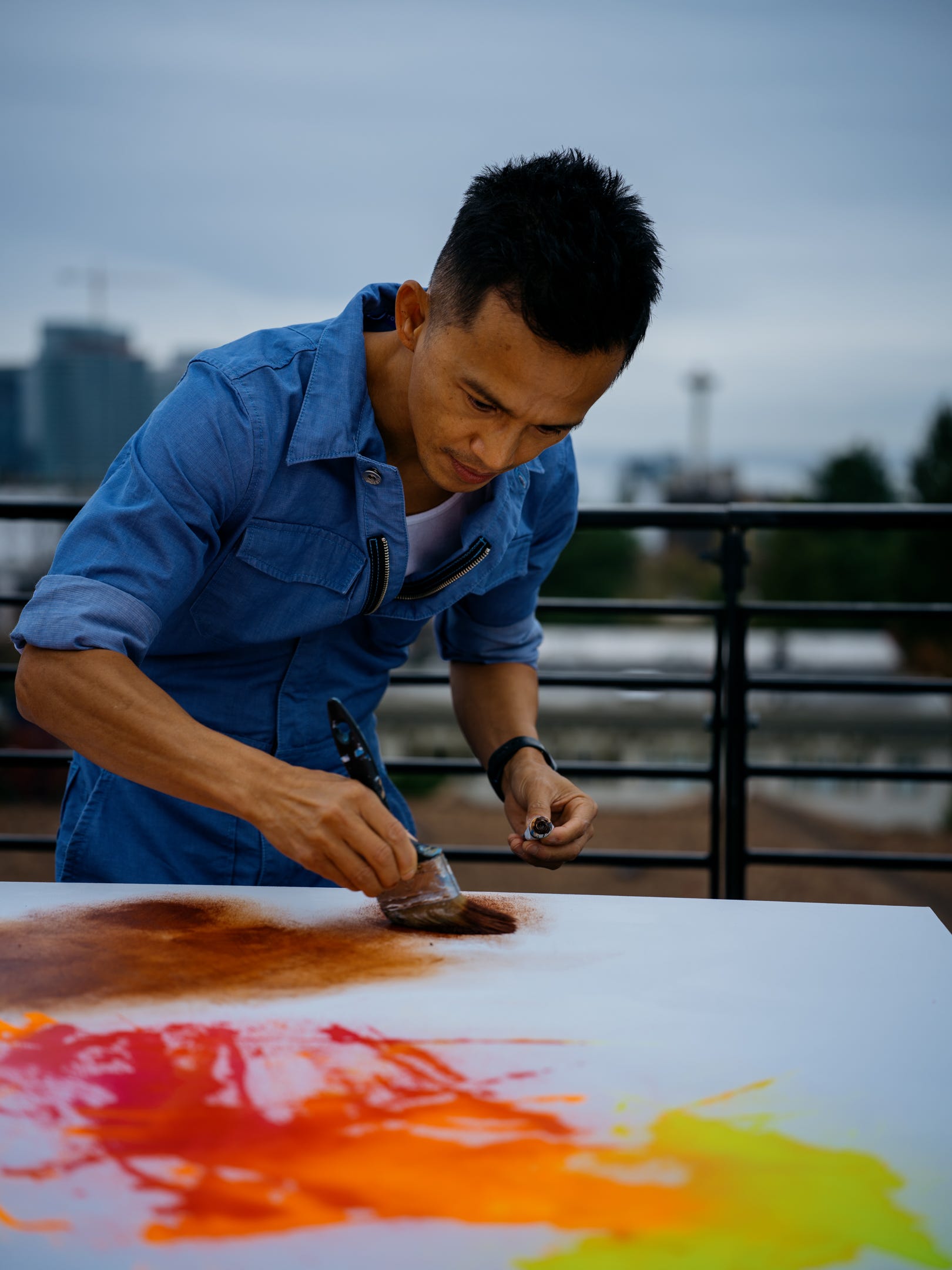
You describe making as a series of intense moments - “a creative tunnel of exploding colors and ideas waiting to come to life”. What triggers that state, and how do you enter/exit it?
It usually happens when I let go — when I stop trying to control what the painting should be and just feel my way through it. There’s a moment when everything quiets down and it’s just me and the work, almost like time disappears. It’s emotional, almost meditative. I’m not thinking; I’m feeling.
Coming out of it can be disorienting — like waking from a dream. I’ll look at the piece and realize it captured something I didn’t know I was trying to say.
Your works sit between landscape and psyche. What compositional decisions help you walk that line?
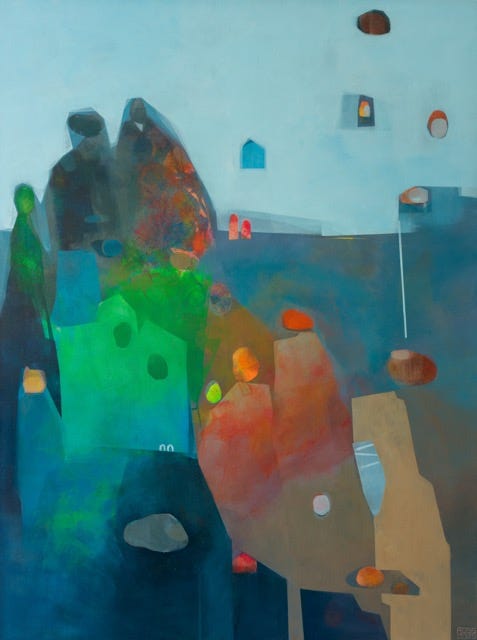
Balance — how to suggest a place without fully describing it. The edges and voids are where that tension lives. I’ll often leave a horizon implied—through a shift in tone or texture—so it feels like something is there but can’t quite be named.
The voids matter too; they give the work space to breathe and let the viewer project their own weather. Sometimes the edges dissolve completely, as if the landscape is fading into thought. Those decisions help me move between outer and inner space—between what’s seen and what’s felt.
Viewers often project their own inner weather onto your work. What responses have surprised you—or taught you something about the piece?
That’s one of the things I love most—how people see themselves in the work. Someone will describe a piece as calm when I made it in a turbulent moment, or they’ll find grief in something I felt as hopeful.
Those moments remind me that once the work leaves my hands, it has its own life. It teaches me to let go a little—to understand that emotion doesn’t belong only to me. It’s a shared space, and I learn a lot from how others walk through it.
Walk us through a piece from first mark to last—substrate prep, early layers, late notations.
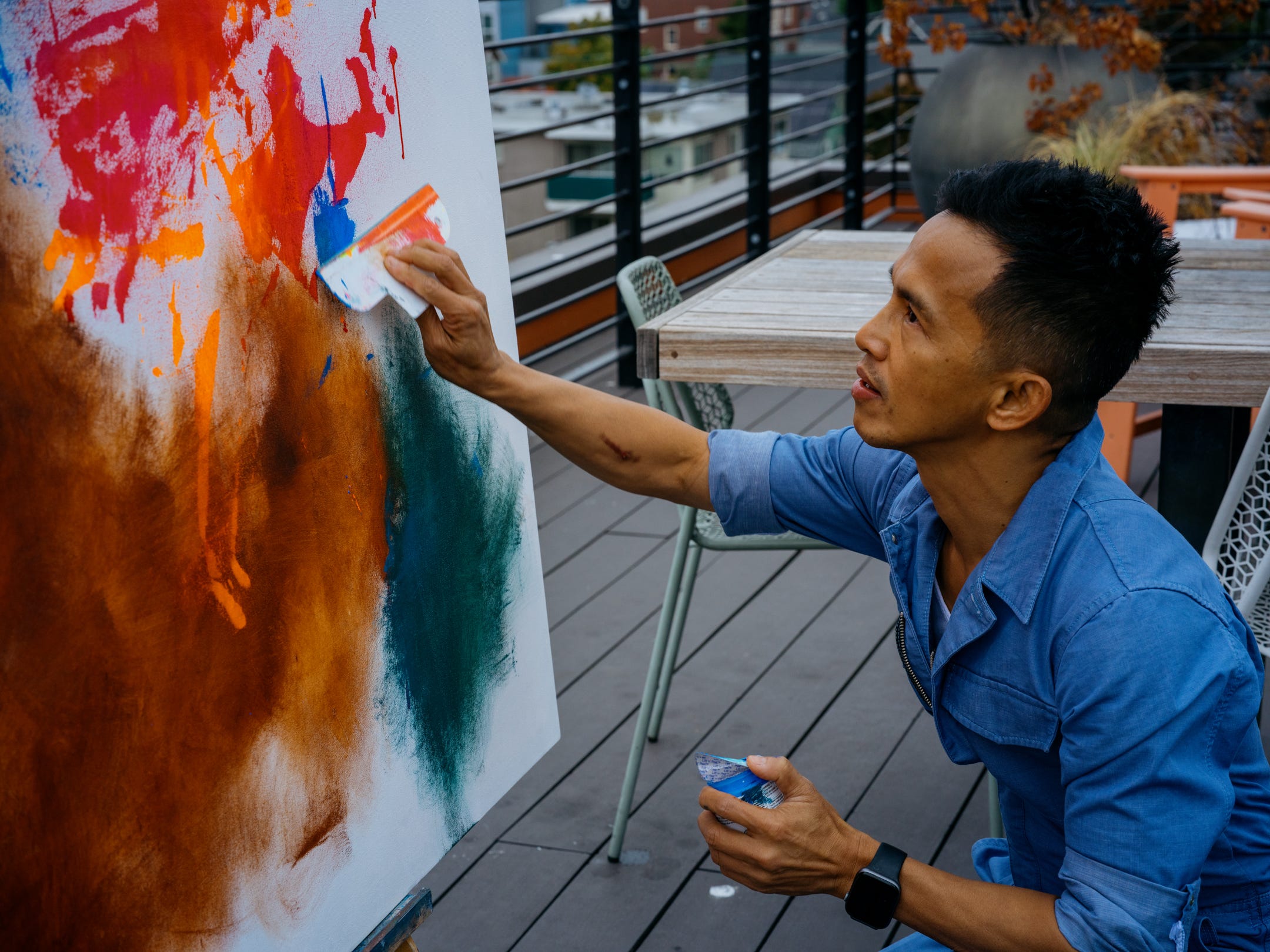
I usually begin on canvas primed with gesso but left a little imperfect—I like when the surface already has some texture or history. The first marks are loose and spontaneous: layers of bright acrylics put down almost randomly. It’s about building energy, setting an emotional base before I know what the piece will become.
I add, scrape, wash things out, [and] let areas dry partially so colors blend unpredictably. As layers build, a kind of landscape starts to emerge—not literal, but atmospheric. Sometimes I see figures or traces of presence and follow them if they feel right.
The rhythm shifts between fast and slow: bursts of movement, then long pauses where I just look and wait for the surface to say what’s next. When the main forms settle, I focus on smaller details. I love adding oil pastel and colored pencil late—tiny gestures, faint lines, unexpected color notes you might not see right away. Up close, [the small marks] create a quiet intimacy, like whispers under the larger movements. They matter to me—they give viewers something to discover slowly, something that rewards.
“Up close, [the small marks] create a quiet intimacy, like whispers under the larger movements. They matter to me—they give viewers something to discover slowly, something that rewards.”
LOTA Fast Three: Questions for every artist we feature
A color you can’t quit—what does it do inside your work?
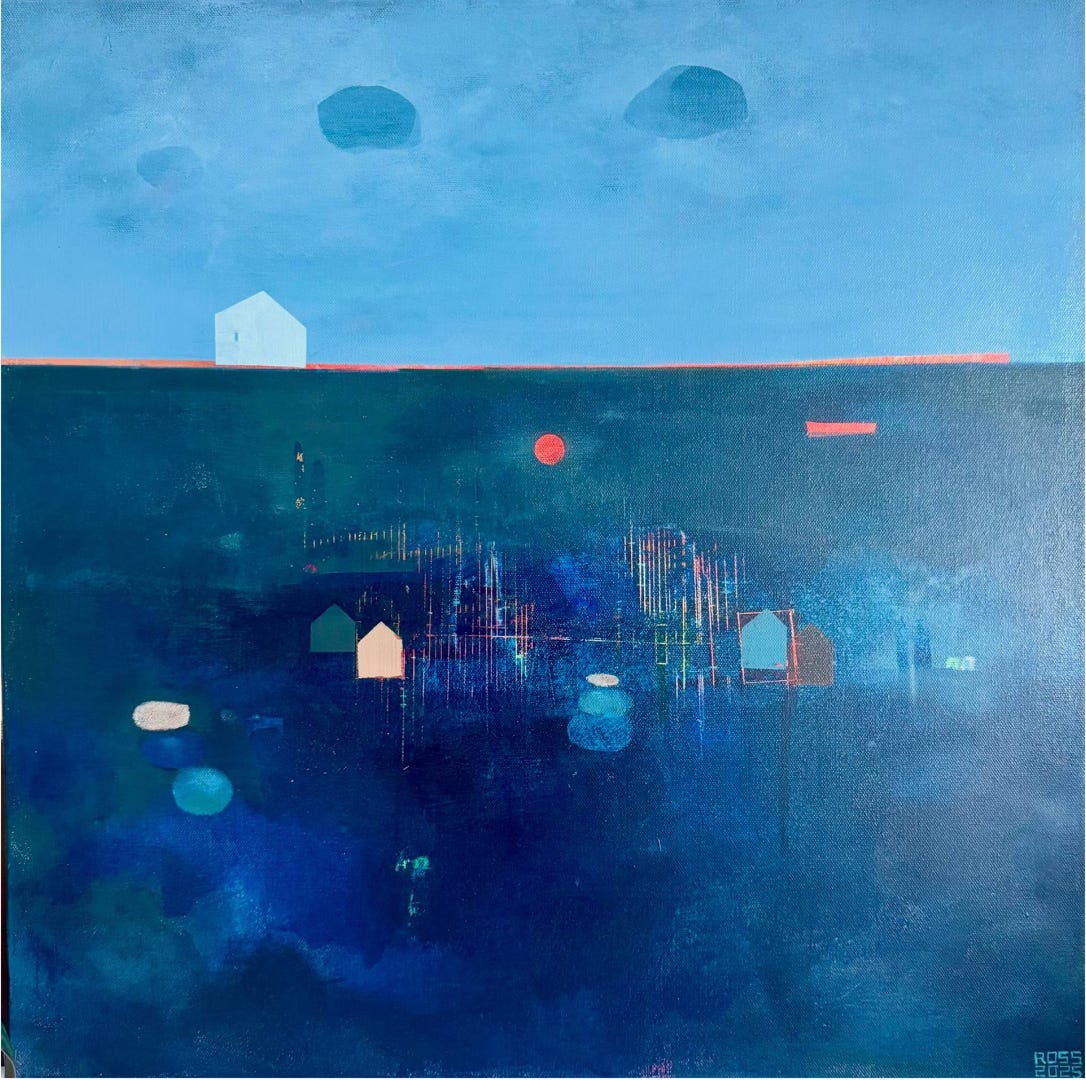
Blue keeps finding its way back in, even when I think I’m done with it. It can be soft and quiet, but also deep and emotional. It’s space, distance, memory—all in one color. In the work, blue grounds everything else; it holds the atmosphere together. It’s become part of my language without me trying—it’s just there, always.
Studio object—one non‑art thing you keep nearby?
Plants. They make the space feel alive. I like seeing them change—new leaves, little signs of growth. It’s a reminder that things take time, that process matters.
An artist who inspires you—who, and what do they teach you?
I don’t really have one artist who inspires me. It’s my surroundings and what I experience every day—the environment, light, movement of people, memories of places I’ve been. It’s less about looking at someone else’s work and more about noticing what’s already around me, what I’m feeling in a moment. That’s what keeps me creating.
Thank you Ross for sharing your story, process, and work! You can follow Ross on Instagram @ross.collado and buy his work on Saatchi Art.
All images courtesy the artist.
Note: This post contains some affiliate links, so if you chose to purchase something via a link with an affiliate fee I make a small commission at no cost to you.